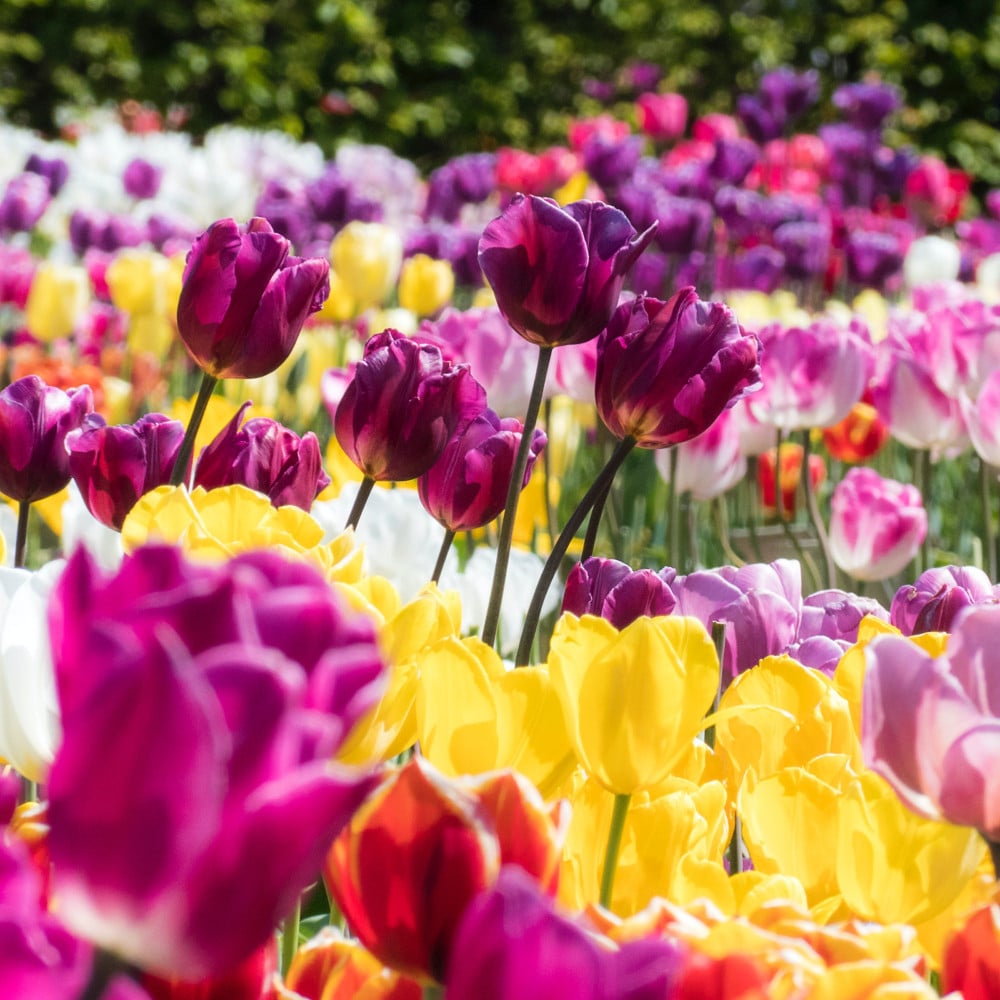
There are 7 different fragrance families in perfumery, which allow us to classify them (citrus, floral, ambery or oriental, chypre, woody and aromatic). The floral family is the richest and broadest aromatic family in existence, and floral fragrances are also highly regarded and popular all over the world.
Floral notes are those that can be described as “single” or “abstract” notes that are numerous and very different from each other. Therefore, it is impossible to love all floral perfumes, as their scents are diverse and specific, and you often come across a love of a certain category of flowers.
In perfumery, there are also what are called “floral bouquets”. These floral notes can be found in all olfactory families and are often found in the heart of the fragrance.
Flowers are raw ingredients used in perfumery. There are even different categories of flowers in perfumery:
- Green, spring or plant flowers
- White or sensual, solar flowers
- Roses
- Spicy flowers
- Powdery flowers
- Rare flowers
Spring flowers or renewable flowers
Spring flowers, also known as rejuvenating flowers, evoke freshness, sweetness and joy, with a dominant green and vegetal character.
Unfortunately, some of these flowers do not give off their scent, although they are very fragrant. They are called silent flowers, such as lilac, buddleia (lilac with honeyed hints), honeysuckle, lily of the valley, oriental hyacinth, and sweet pea.
Whatever extraction process is used (steam distillation, extraction with volatile solvents, or other), none of them can recreate the original scent of these flowers.
If the perfumer wants to obtain “muted” floral scents, he has to reconstruct these notes so the perfumer will work to recall and restore the scent in his own way. Recomposition is the outline of the perfume and is like the basic components of the scent. It consists of approximately more than ten components, between artificial and natural. Therefore, without this great work, we would not have seen, for example, the Diorissimo perfume in the year (1956), which is truly an example of “soliflore”, as it Its configuration takes a lot of effort and time.
In the spring flower family, only two flowers are natural in perfumes: daffodils and daffodils, whose scent is exactly the same.
Narcissus _
The genesis of narcissus
Narcissus comes from Central Europe, North Africa and Asia, the main producing countries are France (Auvergne Rhone), Morocco and Egypt.
crop
The daffodil grows throughout the Barrak region of France, at an altitude of 1,000 meters above sea level. In the spring, pickers pick the flowers with special combs (a kind of large rake), and more recently with a motorized cart. The most important production now in the Auvergne-Rhône is this flower. It is highly sought after by perfumers, who use it mainly in luxury perfumes, as well as in some floral or chypre fragrances (see the chypre family).
Narcissus, beautiful in appearance, spreads a strong fragrance with a very green scent, very earthy, slightly spicy, animalic, with touches of jasmine and ylang-ylang. It's hard to work with (the green side of it).
Narcissus: Sister of Narcissus
Daffodil is a flower that produces its fragrance through extraction with volatile solvents and offers a particularly distinctive scent with an unparalleled spring freshness.
Fragrance example: la haie fleurie - l'artisan parfumeur
White flowers
White flowers are also called sensual or psychedelic flowers, because they often share an indole molecule, a natural animal note. Among the white flowers there are:
- Jasmine
- Tuberose
- Ylang ylang
- Frangipani
- Tiare flower
- Gardenia
- Magnolia
- Orange rose
- Jasmine: the flower
There are two types of jasmine:
Jasmine (grandiflorum), which can come from France (Grasse), Egypt, India or Italy.
Jasmine Sambac from India with an orange-yellow scent.
In order to harvest this natural substance, pickers have to wake up very early and the most skilled pickers collect 500 to 700 kg of flowers per hour, and up to 10,000 flowers have to be obtained to obtain 1 kg of essential oil.
Tuberose _
Tuberose is a strange and somewhat quiet flower. It comes from southern India and Egypt. In India, for example, it is harvested every morning from May (5) to December (12). In India, the name of this flower means night fragrance.
Tuberose is found naturally in the perfume industry, and it is very expensive. In the past, the oil was extracted in the traditional way. Now it is obtained by extraction with volatile solvents. Tuberose gives off a calm, creamy scent. At first, it gives off a somewhat medicinal scent, but after a few seconds it gives off a pleasant, creamy scent. A unique scent between sweet nectar and intoxicating nectar, and a strange, sweet scent, a captivating and exciting scent.
Some brands cannot afford natural tuberose and in this case it is always possible to recreate it synthetically (the scent will always differ slightly from the scent of the natural flower). It is a mixture of different notes: natural jasmine, or a combination of jasmine, ylang-ylang, indole, coconut. Orange hint, heliotropin, mimosa, and other elements.
Ylang-ylang ( Ylang-ylang )
The ylang ylang flower comes from a tree, its shape is like a big star. In Indonesian it means flower of flowers. It is very strange and has an intense smell. This smell was inherited by virtue of its proximity to volcanoes (Madagascar or Mayotte). The floral side of it is sharp and pungent and gives many facets in perfumes. It is harvested when the flower turns. Delicate green to yellow in color, which is a sign that it has reached the stage of olfactory maturity. Its scent comes between jasmine and tuberose and reminds you somewhat of the ylang-ylang flower, and its dense floral notes, of solar energy monads.
Frangipani flower
The frangipani flower is a sacred flower in India, where it is called fervent prayer in India because of the abundance of its flowers, such as jasmine. The whiteness of the flower symbolizes the purity of the soul. This delicate sacred flower does not emit a scent. Perfumers must use a “flower-mimicking accord,” by designing and recreating the scent. Meaning, perfumers have to deal with dozens of synthetic and natural ingredients to capture their scent.
Tiare flower
The national symbol of Tahiti, the white tiare flower, grows on tropical trees and is now available as a natural product, but it is used sparingly, as its scent in the end was quite disappointing and is a far cry from the sweet scent and creamy character of the flower.
Gardenia _
Gardenia is a small tree with very aromatic white flowers. It comes from China, Japan, the Philippines, Indonesia, India and California. The extract of gardenia oil (gardenia absolute), which is obtained from extracting the gardenia flower, is not at all identical to the smell of the flower in its natural state. It is simply used to isolate a substance. Styrallyl acetate: The ingredient has a green rhubarb scent.
Magnolia _
Magnolia belongs to the Magnoliaceae family and comes from a tree native to East Asia and China.
A group of diverse Michelia alba flowers interesting in the perfume industry. They are harvested from May (5) to June (6) and from August (8) to November (11) and the flowers are processed by distillation to obtain magnolia essential oil.
This floral component, with its noticeable citrus facets, has a wonderful lemony freshness accompanied by green hints and then a soft sunny floral aspect appears with touches of vanilla. The leaves are also used in perfumery, although they are difficult to work with.
Orange blossom
Neroli comes from the bitter orange tree, which is a magical tree because it provides 4 different raw materials at the same time:
- Bitter orange, whose peel is extracted by cold pressing and produces bitter orange extract.
- Orange blossom extract.
- Orange flower oil.
- Orange leaf oil.
The bitter orange tree is native to East Asia, but is now grown in the Mediterranean basin. The main producers of orange blossoms are Tunisia and Morocco. Italy, Egypt and France (south) also produce orange blossoms.
Processing and manufacturing of raw materials
White flowers are usually too delicate to withstand steam distillation, and orange blossom is the only one that can withstand both extraction methods:
Distillation: Neroli essence is produced by steam distilling the flowers.
Extraction with volatile solvents: Extraction with volatile solvents produces orange blossom Abs.
Finally, by distilling the whole branches (leaves and flowers) together, we obtain an extract of small grains called (Petit grain essence).
Olfactory description of orange flower
We will mention some descriptions of orange blossom products, from the most refreshing and most aromatic to the most intense:
- Small Grain Oil: Lavender, green/vegetal scent, very refreshing citrus scent, sometimes smoky.
- Orange Blossom Oil: Refreshing, cool/airy, sweet, slightly herbal, citrusy, fresh orange blossom.
- Orange flower extract: It has some animal features (an animal note of white flowers), which adds an intense character to the opening of the perfume. It has a calm, animal and sensual side. Its scent appears strongly at the beginning and then turns to honey features.
Use orange flower
Neroli oil and orange flower extract are not used for the same purpose. Neroli oil is associated with citrus perfumes and eau de cologne. It is also used to recreate certain flowers such as tuberose, hyacinth, tiare and frangipani. Neroli is found in the top notes of perfumes. Fresh flowers.
Orange blossom Abs is best used to create chypre accords, oriental perfumes, or white floral perfumes. It is often used to recreate exotic and rare flowers, such as gardenia or tiare. It is often present as a heart note and can also be used to highlight fruity notes such as apricot (see Fruity Aspects).
Roses and rose notes
Among the rose notes there are:
- Roses
- Geranium flower
- Peony
Rose _
Assets
The rose is considered one of the most important ingredients in the perfume industry. The rose comes from different regions: southern France, Bulgaria, Turkey or Morocco. Two types of roses are used in the perfume industry:
- Rose de mai or Centifolia rose that comes from France (Grasse).
- Damascus roses that come from Bulgaria, Türkiye or Morocco.
Processing and manufacturing of raw materials
The rose is one of the few flowers that can withstand extraction with volatile solvents as well as steam distillation which produces rose oil. However, the latter technique is still an expensive option, as it requires about 4 tons of rose petals to produce one kilo of essential oil!! Moreover, it must be harvested very early at 6 am.
It is also possible to obtain rose essence (Rose Abs) by extraction with volatile solvents. This results in a denser and richer oil essence that acts in particular as the heart and base of the perfume. In order to ensure consistent quality from year to year, the rose is often the result of a mixture of different oils. This makes it possible to obtain uniform quality.
Olfactory description of rose
- May Rose of Grasse: honeyed, rounded, warmer, slightly waxy scent.
- Damask rose from Bulgaria or Türkiye: fresher lemon with a citrusy aroma with a jolt.
the use
Rose is traditionally used in floral perfumes and can smell fresh, like a rose opening in the morning, or darker and more oriental.
Geranium flower ( geranium )
Native to Africa, the geranium flower uses the aromatic properties of its leaves and stems, and is grown in many countries but comes mainly from Egypt. Its scent is a rose component, but also has a green, aromatic, slightly minty hint, and can excite and highlight components if used as an herb. Lemon and lychee. It is in some way a masculine rose, which goes well with aromatic notes. Geranium is often found in perfumes that contain ferns.
Peony ( geranium )
Peony is also a rose component. However, it is difficult to obtain the essential oil by extraction, but in perfumery it is necessary to reconstitute it with rose essence and other refreshing elements that are naturally present in rose (phenylethyl alcohol, geraniol). Fruity ingredients can be added, such as raspberry. Blackberry, sometimes a slightly powdery note, like heliotropin.
Spicy flowers
Among the spice flowers used in perfumery are carnations, carnations, and immortelles.
Carnation flower
Egyptian clove flower extract is a natural product found in the perfume industry. However, it is not widely used because it does not resemble the scent of spicy cloves that we all know. The scent of clove flower is often recreated with a mixture of rose and spices (cloves, vanillin and heliotropin).
Wallflower _
Wallflower has a very spicy scent with hints of carnation as well as hints of vanilla and musk. It is created synthetically (accord).
Immortal flower
Immortelle is a yellow flower that grows in Spain and France and its botanical name is Helichrysum. In perfumery it is extracted by distillation. It smells very spicy, sweet, has hints of honeyed tobacco and is considered a very difficult material to work with.
Powdery flowers
Powdery flowers used in perfumery are iris, mimosa, cassia, rose violet and heliotrope.
Iris _
It is not the flower that is processed but its rhizomes (an underground stem on which so-called adventitious roots can form), which come from Italy or China. It takes three years to grow the root and three years to dry it. It is one of the most expensive raw materials in perfumery.
Orris roots have a distinctive scent, as do violets and mimosa because of their distinctive powdery scent. Orris root is credited with woody notes, and also some hints of carrot seed (sometimes carrot seed essence is added to highlight its effect in the fragrance).
Iris can sometimes have an earthy and dry side, when the perfumer emphasizes its rooty side in a fragrance and yet it is a raw material that smells very elegant when on the skin.
Iris is used as a powdery scent model in perfumes. Iris brings a powdery, dry and not-so-sweet scent to perfumes, which is a very elegant scent with a velvety touch. They are often used in aromatic accords to give the floral scent some powdery hints.
Mimosa
Its name comes from the Latin word mimus, which means to stuff or shrink, in reference to some of its leaves that retract and shrink when touched.
There are two types of them:
- Depatla
- Francia
Mimosa is a difficult flower to handle in perfumery. It is grown mainly in southern France, India, Egypt and Morocco. This flower is processed by extraction with volatile solvents, a technique that makes it possible to obtain the aromatic extract from it. The scent of mimosa is floral -powdery and almondy as well with fairly pronounced green undertones, it sometimes shares notes with violet leaves, and may also have overtones of cucumber or even watermelon, as the leaves are distilled at the same time as the yellow flower balls.
Cassie _
The cassia flower is a flower of the acacia family, just like the mimosa (unlike the latter, there are thorns on the cassia branches). Like mimosa, the cassia flower is a difficult flower to work with in perfumery. Its scent is more intense and mysterious, with animalic overtones close to those of ylang-ylang, and it has an adhesive effect at its beginning. The cassia flower is rare and reserved for luxury perfumes. It has a grassy, powdery, spicy, woody aroma. Balsamic, honeyed, but also with hints of anise, cassia blends wonderfully with iris, mimosa and violets. Cassia is native to India, and is also grown around the Mediterranean, especially in Egypt and the subtropics.
Violet rose
Thanks to chemical compounds (ions or methyl ions) we get the scents of violet roses in perfumes. The first (ionone) was discovered in 1890. The ions (Ionone or Methyl Ionone) allowed perfume scientists to reproduce the scent of violet flowers in an actually identical way. The violet rose in its form Natural has no smell!!
Heliotrope flower
It is a flower that belongs to the Boraginaceae family. It is a flower that has no aroma when extracted, but it was discovered artificially in 1869 by chemists Fittig and Milk. It can also be obtained from Tahitian vanilla because helletrope is considered a flower that has a hint of vanilla in it, and its scent is described as floral, sweet, with features of mimosa and a powdery side of lilac.
Rare flowers
There are rare flowers used to make perfumes, for example:
Reseda _
This herbaceous plant with aromatic flowers forms subtle hints of honey, lily of the valley and narcissus.
Champaca _
Champaca is a very aromatic white flower that is used in its natural form and is highly prized in perfumery. It contains ambery notes, as well as a hay scent, honeyed notes, and some ylang-ylang features.
Broom flower
The brome flower is a fragrant and poisonous golden-yellow flower found primarily in the south of France that has a pungent scent with fruity hints, resembling orange blossom in some qualities as giving a honey-tobacco character to the scent.
Pittosporum flower
Betburm is native to Australia, South Africa, Southeast Asia and southern France. It is a small tree with shiny evergreen foliage and greenish-white flowers. Its oil is impossible to obtain, so its floral fragrance is recreated between orange blossom and jasmine.
Mahonia _
Mahonia is native to America and Asia. It is an evergreen tree with thorny leaves that resemble marigolds. It has light, slightly honeyed features, lily of the valley, and daffodils.
Karo Karunde ( Karo Karoundé )
It is a spice flower from South Africa. It is used as a natural product in the perfume industry and has a scent close to that of narcissus. It has a very green scent as well as a mixture of “leathery-animal” scent.
Honeysuckle ( Honeysuckle )
It is like a lily of the valley or a lilac, a silent flower that does not emit its scent. Its secret is difficult to penetrate! Therefore, whoever wants to produce a perfume must mix natural and synthetic ingredients to simulate them, and try to get closer to its somewhat delicate scent between refreshing jasmine and orange flower with slightly honeyed touches. There are very few perfumes on the market based on honeysuckle, as its scent is difficult to tame.